

Owning an investment property in Australia can be rewarding, but understanding investment property tax deductions in Australia is important. Claim the right deductions to help reduce tax, ease cash flow and maximise returns, while staying compliant with the ATO.
Why Property is a Long-Term Investment
So what happens to (say) a $1 Million property in 5, 10, 15 or 20 years if the average increase in value is 4%, 6%, 8% or 10% every year?
As you can see, your equity will grow significantly over the medium to long term. The trick is to hold the property for the long term.
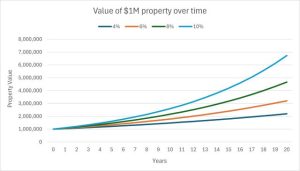
| Year | 4% | 6% | 8% | 10% |
|---|---|---|---|---|
| 0 | 1,000,000 | 1,000,000 | 1,000,000 | 1,000,000 |
| 5 | 1,216,653 | 1,338,226 | 1,469,328 | 1,610,510 |
| 10 | 1,480,244 | 1,790,848 | 2,158,925 | 2,593,742 |
| 15 | 1,800,94 | 2,396,558 | 3,172,169 | 4,177,248 |
| 20 | 2,191,123 | 3,207,135 | 4,660,957 | 6,727,500 |
Long-term holding of Investment Property has other advantages as well. Over the years, the rent you receive will continue to increase broadly in line with inflation. Meanwhile, as you’re paying off your loan, the balance owing will decrease, which further helps your equity and ability to borrow for additional properties in the future.
Taxable Income from Investment Properties
Let’s say you’ve bought your first Investment Property, and you’ve engaged an Agent (highly recommended) to look after the tenancy and keep you at arm’s length from the tenants.
If you own an investment property, you’ll need to declare:
- Rental income
- Tenant reimbursements (e.g., water usage, provided your property qualifies)
What You Can Claim as Deductions
You can claim a wide range of expenses, including:
- Agent Fees – including the standard fee; advertising for tenants, letting fees
- Body Corporate Fees – if it’s a Unit or under strata title
- Borrowing Expenses – the fees charged up front by the lender can be claimed over 5 years
- Cleaning – including a Bond clean at end of tenancy
- Council Rates
- Gardening
- Insurance – can be Building & Contents and/or Landlord Insurance
- Interest – paid to your lender. Only the interest is deductible, not the total repayments.
- Land Tax – if you own a number of properties (excluding your own home)
- Legal Fees – in case of tenant disputes, but fairly unusual
- Pest Control – should be done annually
- Repairs & Maintenance – only for wear and tear caused by the tenancy and excludes Initial Repairs (complex area)
- Water Rates
- Smoke Alarm inspection fees – required annually
Complex Deductions: Depreciation and Capital Works
Some deductions are more technical:
- Capital Allowance Assets – Depreciation (at various rates) on assets valued over $1,000 purchased for the property that are not classified as Repairs & Maintenance (Complex Area) Assets between $300 and $1,000 go into what’s called a Low Value Pool and are depreciated @37.5% per year.
- Capital Works deductions – Depreciation @2.5% on items classified as part of the building. (Again, this is a complex area)
💡 Pro Tip: Always get a Depreciation Schedule when buying property. It helps identify claimable allowances and deductions, especially for newer properties.
A Depreciation Schedule prepared at the time of purchase is highly recommended as this identifies what can be claimed as Capital Allowances (for new buildings only) or Capital Works deductions for post 1984 built properties.
Why Speak to an Accountant Before You Buy
If you are thinking about buying an Investment Property, please talk to us first.
While we are not Licenced Financial Planners and can’t recommend which property you should buy or even whether a property investment is right for you, we can certainly fully explain the tax implications of property investment.

Newman Borg is the Director of Depoltz Accounting, specialising in accounting, taxation, and business advisory for individuals and small to medium businesses. With decades of experience, he helps clients navigate complex financial and tax matters. Newman values integrity, personalised service, and practical solutions that minimise tax and maximise business success.